

You sit down on Monday with a sensible plan for the week aaaand… by Wednesday it's in pieces. The 'quick' newsletter ate a whole afternoon, the lead you meant to reply to is still sitting in your inbox, and you're doing the invoicing at 9pm, telling yourself I'll catch up at the weekend. If that sounds like your week more often than you'd like, read on…
This is the Passion Paradox: you love the work you do, but doing the work you love is breaking you, because all the boring but necessary admin ends up squeezed into the gaps, or not done at all. And let’s be honest, if you’re busy the ‘gaps’ end up being when you should be resting or when you don’t have enough time to get it done properly.
Time management tips for self-employed practitioners: part two
Back in 2024 I wrote the blog Overwhelmed and Underpaid: Welcome to Your Business. It covered the basics. Find your natural rhythm, keep one calendar and one to-do list, protect time for deep focus and plan your week. If you haven't read it, start there, because those guidelines still hold up.
This post is what I've learned since: how to build a schedule that bends without breaking. In the More Profitable Me® Framework, this is Time Calibration, simplifying how you plan so it works every week, not only on the good ones.
Why every task takes longer than you think
I'll go first. I always underestimate how long things take. I have ADHD, and one way it shows up for me is time blindness, which means I don't feel time passing in the same way other people do. Left to my own devices, I plan far too much into a day, or I get stuck on one thing and look up to find the afternoon has disappeared.
What helps is data, not willpower. I time track as much as I can, so I know how long a task really takes rather than how long I hoped it would. Try it for a couple of weeks on your regular jobs, like invoicing, replying to enquiries or writing your newsletter. Then, next time you estimate a task, ask yourself whether you should double it. The answer is usually yes.
Build in buffers and flex slots
Even with better estimates, things overrun. The tech plays up, or a task turns out to have three steps you didn’t think about before you started. A buffer slot after a big piece of work gives it somewhere to spill into, instead of pushing everything down the line until it lands in your downtime.
Flex slots do a similar job, so don't plan every minute! I don't do well with my whole calendar blocked out. When I look at a really full schedule, I feel a resistance to starting any of it, and I can't guarantee I'll be in the mood for a particular task at a particular time on a particular day.
So, I plan with a lot more flexibility. On Sundays I look at what’s coming up with a focus on next week; it’s intentional and helps me see where my deadlines are, and how much time I have to hit them. Then each day, I choose what to work on based on my energy and interest. The deadlines are fixed. The order isn't. (BTW, if you think this means I’m never up ‘til 2am sliding something over the line at the last possible minute, wait for the deadlines section! 😂)
Protect time nobody can book
One of the most useful things I've done is take some time off the table completely. I have two days a week where clients can't book in, which gives me structured focus time without interruptions. My booking system only offers my three client-facing days. If I really need (or want) to, I can override it, but then my VA, Hannah, books the client in manually, so it's a decision rather than an accident.
In a five-week month, I also block the fifth week so nobody can book meetings. That's my time to catch up, or to develop things for my own business. Even one meeting-free day a week gives the rest of your business room to breathe, so be brave, take out that diary or fire-up your online calendar and block a day now, your clients will still book you!
Deadlines: set them, and ask for them
Give yourself deadlines, even for the things nobody else is waiting for. Without a date, the website update or the new workshop idea stays on the 'one day' list forever. Putting a deadline in your diary is how you go from 'one day' to 'Day One'.
If you do work for clients between sessions, ask them for deadlines and hand them out too! VAs know their most valuable question is 'When do you need this by?', and the ‘I need this by X date’ is the flip side you can use with your clients. It stops you treating every request as urgent, and them expecting you can magic a solution with 12 hours’ notice.
Now it’s time to own up! Sometimes I still do things at the very last minute, because nothing focuses my mind quite like a tight deadline. It can even make a task feel engaging when it didn't before. Productive procrastination is a real thing. In my house is the kitchen is ‘show home level’ spotless, you know either the cleaner has just left OR I am avoiding doing something else that feels hard to start. And I absolutely HATE cleaning, so things must be bad if that is the ‘fun’ alternative 😂.
That avoidance of a task inevitably leads to a mandatory five-hour focus session after my husband has gone to bed. I am not proud of it, but I've stopped fighting it. I know my brain prioritises by interest and urgency, so I try not to force it to do a task it doesn’t want to do. If I did it would definitely take twice as long and wouldn’t be as good. An impending deadline brings the excitement the task was missing before, and that’s all I need.
And no, I wouldn’t recommend it as a plan. Good time management doesn’t mean every week looks the same. It means knowing how your brain works and planning around it, so a late night stays the exception and never becomes the routine. Judge if you dare!
The Eisenhower Matrix: The most useful tool I don’t use.
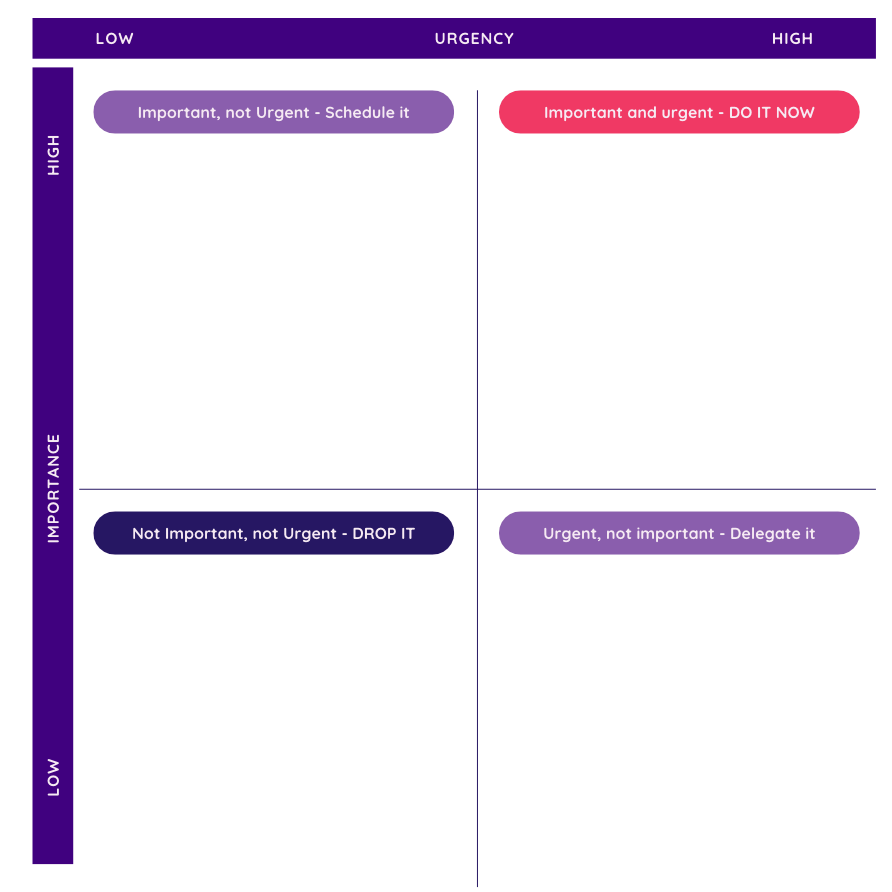
The Eisenhower Matrix is a simple way to prioritise. You sort every task into one of four boxes, based on whether it's urgent and / or important:
Urgent and important: do it now.
Important but not urgent: schedule it.
Urgent but not important: delegate it, ideally to a specialist who does that task all the time and will likely do it better and faster.
Neither urgent nor important: drop it.
I used it successfully many times in my corporate career, and it's well worth a try. But when I went self-employed, I realised part of what made it work was the team around me. On your own, 'important but not urgent' is exactly the box that slips down the list, because nobody notices except you.And for my brain, 'important' doesn't drive action the way interest and urgency do. If importance alone doesn't get you moving either, the next tip might help more than any matrix.
Get things done with other people
In the past, I've run ‘progress days’, both online and in person, with a couple of members of my C-suite. That's the circle you build in Get Connected, the fourth pillar of the More Profitable Me® Framework.
Progress days are built on The Pomodoro Technique, a time management method created by Francesco Cirillo in the late 1980s. He named it after the tomato-shaped kitchen timer he used as a university student (pomodoro is Italian for tomato). You plan what you want to work on and use short, focused blocks to give your attention to one task without distraction. Then you take a break. There are more benefits than just getting stuff done. Understanding how long things take to refine your estimates, being intentional about the work you want to achieve, and learning that eliminating distractions (multitasking is one) makes you more productive overall are just a few.
On our progress days, everyone works on their own thing. Online, it's cameras on and mics off while we work, and chat in the breaks so it feels like having your own team there supporting you.
We populate a shared online whiteboard with digital sticky notes at the start, for the things we each want to do and move them to a communal 'done' column as we finish. By the end of the day, we can all see what we achieved by working on our own, together. If you've got one big task, break it into smaller chunks, so you can see progress and get something into the done column early.
We stick to the well documented cadence of 25 minutes focus time, 5 minutes break, but even two minutes of intentional work is better than none, so no pressure to confirm! 2 minutes might be what you need to trick your brain into getting started; ‘we’ll just do 2 minutes and then stop’ could trigger more flow on a task you’re dreading.
Working alongside other people is a powerful way to get your own things done. Once you know that wandering off task would be disruptive to others, not only you, staying focused gets a lot easier. Book a ‘progress' session with a friend or colleague or join one of mine and see how much you can tick off.
When the plan slips: intrinsic and extrinsic motivation
Some weeks, none of this will go to plan. If what slips is something you promised yourself, like the website update or that new workshop idea, be kind to yourself. It's your schedule, so it's yours to change. A missed slot isn't a failure, it's information, so adjust and go again.
Client deadlines are different. You can't afford to miss something you've promised a client, because their trust and your reputation rest on it. This is where it helps to understand what actually gets you moving.
There are two kinds of motivation. Intrinsic motivation comes from inside you: you do something because you enjoy it, or because it matters to you personally and if you have it, lucky you! (I am so jealous right now!) Extrinsic motivation comes from outside: a deadline, a client waiting, or someone expecting you to turn up.
For me, extrinsic motivation wins the day, every time. Intrinsic motivation is generally not a thing for me, and I think that's my ADHD. So, client work always gets done, and when something I set for myself slides, I cut myself a break. It's also why working alongside other people helps so much, because it adds outside accountability to the things nobody else is waiting for.
What changed for me
Working this way means I always know what needs doing each week and when it's due, so I can follow my energy day to day without losing track of my deadlines. My two client-free days give me proper focus time, and that fifth week is where my own business gets built. Some things still happen at the last minute, and I've made my peace with that, because the system works with my brain instead of against it.
The best time management tips for self-employed practitioners aren't about a perfect, colour-coded calendar, although if that is your thing, I salute you! For the rest of us, it’s about honest estimates, a bit of breathing room and deadlines that keep you moving. Pick one tip from this post to try this week and build from there.
Get organised with me
If you'd like to put these tips into practice, look out for my Organise Me workshop - coming soon!
Frequently asked questions
I am self-employed and always underestimate how long tasks take. What can I do?
Start by time tracking your regular tasks for a couple of weeks, so you know how long they really take. Then, when you estimate a new task, ask whether you should double it. Adding a buffer slot after bigger pieces of work also gives overruns somewhere to go, so they don't push the rest of your day into the evening.
I am a therapist with a busy client diary. How do I find time for business admin?
Protect some time that clients can't book. Many booking systems let you limit which days are available, so you could keep one or two days a week free of client sessions for admin and focused work. Even one meeting-free day a week makes a difference. If you occasionally need to make an exception, book it in manually so it's a deliberate choice.
I am a sole trader. What is the Eisenhower Matrix and does it work when you work alone?
The Eisenhower Matrix sorts tasks into four boxes: urgent and important (do it now), important but not urgent (schedule it), urgent but not important (delegate it) and neither (drop it). It's a useful way to prioritise. It works for some people who work alone but be mindful that the the 'important but not urgent' tasks can slip because nobody else is holding you to them. It helps to pair the matrix with deadlines and some outside accountability.
I am a wellness practitioner and I hate rigid schedules. Do I have to time block my whole calendar?
No. Some people find a fully blocked calendar off-putting, and it can make starting harder. A flexible approach can work well instead: plan your week's priorities and deadlines once a week, leave flex slots, and choose each day's tasks based on your energy. The deadlines stay fixed, but the order can change.
I am self-employed and find it hard to stay focused working alone. Can co-working help?
Yes, for many people it does. A co-working or 'get stuff done' session with a friend or colleague gives you shared accountability. Try The Pomodoro Technique, working in 25-minute blocks with five-minute breaks, and keep a shared list of what you each want to finish. Seeing tasks move to 'done' together is surprisingly motivating.
Sources
• Francesco Cirillo, The Pomodoro Technique
